En
En Cn
Cn


Email:
huaren_inquiry@hdpharm.com
Sep 15, 2026
In 2026, nucleotide chemistry sits at the center of some of the most active areas in pharmaceutical R&D. For drug discovery teams, CDMOs, biotech laboratories, diagnostic reagent developers, and nucleic acid researchers, guanosine 5 monophosphate—GMP Free Acid, CAS 85 32 5—is no longer a peripheral biochemical reagent. It is a strategically important guanine nucleotide that serves as a research intermediate, a precursor in GTP-related synthesis workflows, and a starting point for cGMP pathway studies. As antiviral nucleoside and nucleotide analogue research continues to expand, and as cyclic nucleotide signaling becomes increasingly relevant to immunotherapy mechanism studies, the demand for well-characterized, reliably documented GMP nucleotide precursor for pharmaceutical synthesis is growing across both academic and industrial laboratory settings. Huaren lists GMP Free Acid under its nucleotide portfolio with CAS No. 85-32-5, providing a focused supply option for buyers evaluating nucleotide sourcing for advanced laboratory and pilot-scale research.
The challenge for pharmaceutical laboratories and biotech procurement teams is not simply finding a supplier who lists guanosine 5 monophosphate in a catalog. The real challenge is sourcing a material that supports reproducible research, consistent synthesis outcomes, impurity control, documentation requirements, and scalable R&D workflows—and doing so without the delays, substitution errors, and quality surprises that derail timelines.
In antiviral and immunotherapy-related research, a small variation in nucleotide purity, water content, residual salts, or batch consistency can affect downstream conversion efficiency, assay interpretation, and scale-up feasibility. These are not theoretical concerns. They are the practical reasons why experienced pharmaceutical procurement teams treat nucleotide sourcing as a quality-sensitive decision, not a commodity purchase.
The most common procurement pain points in this category include:
Unclear or inconsistent assay and purity specifications across supplier quotations
Batch-to-batch quality variation that affects reproducibility across experimental runs
Missing or incomplete COA, SDS, or impurity profile documentation
Confusion between GMP Free Acid, GMP sodium salt, GTP, GDP, cGMP, and guanosine—related but not interchangeable compounds
Poor solubility guidance for assay preparation at the required concentration
Moisture control issues that affect weighing accuracy and long-term stability
Limited ability to support gram-to-kilogram scale-up as R&D progresses
Difficulty verifying CAS 85 32 5 identity across supplier documents and internal procurement records
For laboratories working on nucleoside and nucleotide analogue development, these procurement gaps translate directly into experimental delays, failed batches, and compliance exposure during supplier qualification. The key message for B2B buyers is that GMP Free Acid is not simply a nucleotide name on a label—it is a quality-sensitive research input that must be evaluated by identity, purity, documentation, storage compatibility, and synthesis workflow suitability.
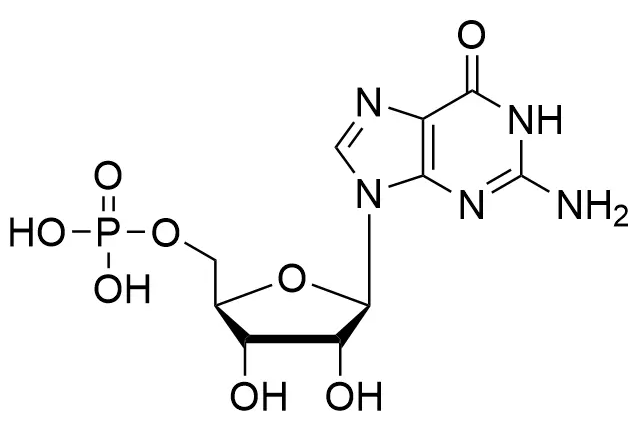
Guanosine 5 monophosphate, also known as GMP, 5'-GMP, guanosine 5'-monophosphate, or guanylic acid, is a guanine ribonucleotide composed of three structural components: a guanine base, a ribose sugar, and one phosphate group attached at the 5' position of the ribose. NCBI MeSH identifies guanosine monophosphate with registry number 85-32-5 and lists entry terms including 5'-GMP, guanosine 5'-monophosphate, and 5'-guanylic acid.
| Item | Description |
|---|---|
| Primary name | Guanosine 5 monophosphate |
| Common abbreviation | GMP |
| Standard form | GMP Free Acid |
| CAS number | 85 32 5 |
| Chemical class | Guanine ribonucleotide / purine nucleotide |
| Research relevance | Precursor for GTP-related pathways and cGMP signaling research |
| Target buyer | Pharma R&D, biotech labs, CDMOs, diagnostic reagent developers, academic labs |
For B2B purchasing, CAS 85 32 5 is not just a reference number—it is the primary verification tool that buyers should use to confirm correct chemical identity across every document in the procurement chain. Specifically, buyers should use the CAS number to verify:
Correct compound identity on supplier quotations and COA documents
Alignment between the ordered material and internal ERP and procurement records
Consistency across customs and shipping documentation
Differentiation from GMP sodium salt forms, which carry different CAS numbers and different physical and chemical properties
Regulatory and safety documentation accuracy
This distinction matters more than many buyers initially recognize. GMP Free Acid (CAS 85 32 5) contains no added sodium counterion. GMP sodium salt forms contain sodium, which affects solubility behavior, pH in solution, stoichiometric calculations for synthesis workflows, and formulation compatibility. Substituting one form for the other without a method review can introduce errors in assay preparation, conversion calculations, and downstream synthesis steps. Buyers should confirm the exact salt form on the COA before ordering and should not accept substitutions without explicit formulation review.
Huaren's nucleotide portfolio lists GMP Free Acid with CAS No. 85-32-5 alongside broader nucleotide categories including NMP, NDP, and NTP materials, providing buyers with a clear identity reference for procurement documentation.
Understanding the biochemical role of guanosine 5 monophosphate in guanine nucleotide metabolism is essential for buyers who need to justify the procurement decision internally and communicate the research application to suppliers when requesting custom specifications or scale-up quantities.
GMP's research value comes from its position in guanine nucleotide metabolism and synthetic workflows. The simplified pathway is:
Guanosine → GMP → GDP → GTP → cGMP
In biochemical systems, GMP can be further phosphorylated toward GDP and GTP. GTP is then the substrate for guanylyl cyclase, which catalyzes the conversion of GTP into cyclic guanosine 3',5'-monophosphate—cGMP—a critical second messenger in cellular signaling.
GTP is involved in a wide range of research-relevant processes:
RNA synthesis and transcription research
Signal transduction and G-protein signaling studies
Enzymatic phosphorylation workflow development
Protein biosynthesis research
Nucleotide conversion and metabolism experiments
cGMP pathway investigation
Importantly for buyers evaluating GMP as a GMP nucleotide precursor for pharmaceutical synthesis, GTP can be prepared by enzymatic phosphorylation of guanosine 5'-monophosphate. This positions GMP Free Acid as a direct upstream starting material in GTP preparation workflows, making its purity, moisture content, and impurity profile directly relevant to the quality of the GTP produced.
cGMP is a second messenger involved in nitric oxide signaling, guanylyl cyclase pathways, smooth muscle relaxation, vascular biology, platelet function, neurotransmission, and multiple other cellular regulatory functions. Research into cGMP signaling has expanded significantly in connection with cardiovascular pharmacology, pulmonary hypertension, and immune cell regulation—all areas where pharmaceutical R&D investment is increasing.
The NCBI StatPearls review explains that guanylyl cyclase converts GTP to cGMP and that cGMP activates downstream signaling proteins including protein kinase G, which mediates many of cGMP's physiological effects. For laboratories studying these pathways, GMP Free Acid serves as the upstream nucleotide reference material and synthetic precursor that anchors the entire experimental workflow.
It is important to position this connection accurately. GMP itself is not an antiviral drug. Its relevance to antiviral and immunotherapy research is as a nucleotide building block and research intermediate in broader guanine nucleotide chemistry and nucleoside/nucleotide analogue development.
In antiviral drug discovery, many nucleoside and nucleotide analogues are designed to become active mono-, di-, or triphosphate forms inside cells, where they can interfere with viral polymerases or genome replication. Recent reviews continue to highlight nucleoside and nucleotide prodrugs and triphosphate-active metabolites as major areas of antiviral research. For laboratories working in this space, access to well-characterized guanine nucleotide precursors—including GMP Free Acid CAS 85 32 5—is a practical research infrastructure requirement.
For buyers moving from initial screening quantities to larger R&D or pilot-scale procurement, the quality evaluation framework for guanosine 5 monophosphate must cover the full specification package—not just the headline purity number.
| Specification | What to Check | Why It Matters |
|---|---|---|
| Identity | CAS 85 32 5, HPLC, MS, NMR, IR if available | Confirms correct compound |
| Assay / purity | HPLC purity, UV assay, nucleotide profile | Supports reproducible synthesis and assays |
| Water content | KF moisture test or loss on drying | Affects weighing accuracy and stability |
| Impurities | Related nucleotides, guanosine, inorganic phosphate | Impacts downstream conversion and assay results |
| Salt form | Free acid vs sodium salt | Affects solubility, pH, formulation, stoichiometry |
| Appearance | Powder, color, visible contamination | Basic QC and incoming inspection |
| Heavy metals | ICP or elemental impurity data if required | Important for pharma R&D qualification |
| Storage | Temperature, humidity, light protection | Protects long-term stability |
| Documentation | COA, SDS, TDS, batch record support | Supports procurement and audit readiness |
| Compound | What It Is | Procurement Risk If Confused |
|---|---|---|
| GMP (CAS 85 32 5) | Guanosine monophosphate | Starting nucleotide and precursor |
| GDP | Guanosine diphosphate | Higher phosphorylation state, different reactivity |
| GTP | Guanosine triphosphate | Energy-rich nucleotide, cGMP precursor |
| cGMP | Cyclic guanosine monophosphate | Second messenger, signaling research use |
| Guanosine | Nucleoside without phosphate | Different compound, different reactivity |
Each of these compounds has a different CAS number, different physical properties, different solubility behavior, and different roles in biochemical workflows. Ordering the wrong compound—even from a reputable supplier—can invalidate an entire experimental series. Buyers should confirm the exact compound name, CAS number, and salt form on every quotation and COA before approving a purchase order.
For laboratories moving from milligram-scale screening to gram or kilogram quantities, the supplier's ability to maintain consistent quality across batch sizes becomes a critical evaluation criterion. Buyers should request multi-batch consistency data, confirm that the supplier can support the required scale, and verify that documentation standards—COA format, impurity reporting, moisture data—remain consistent as order quantities increase.
Huaren's nucleotide portfolio covers NMP, NDP, and NTP categories alongside GMP Free Acid, which is relevant for buyers who need a single nucleotide-focused supplier to support multiple compounds across a research program rather than managing separate suppliers for each nucleotide type.
High-quality guanosine 5 monophosphate serves a broad range of advanced research environments:
Pharmaceutical R&D laboratories developing nucleoside and nucleotide analogues
Antiviral drug discovery teams working on polymerase-targeting strategies
Immunotherapy mechanism research laboratories studying nucleotide signaling
cGMP pathway researchers investigating guanylyl cyclase and downstream effectors
CDMOs and CROs supporting client nucleotide synthesis programs
Diagnostic reagent developers requiring well-characterized nucleotide reference materials
Molecular biology reagent companies developing enzyme-based assay systems
Academic research institutes studying purine metabolism and nucleotide biochemistry
Biochemical assay developers requiring consistent nucleotide inputs
Nucleic acid drug research groups working on RNA-based therapeutic platforms
Enzymatic phosphorylation workflow developers preparing GTP from GMP
Clear CAS 85 32 5 identification supports procurement documentation accuracy
GMP Free Acid form avoids sodium counterion interference in synthesis workflows
Nucleotide-focused supplier reduces risk of compound substitution errors
Consistent purity and impurity profile supports reproducible experimental outcomes
Documentation package supports laboratory procurement and supplier qualification
Useful precursor positioning for GTP synthesis and cGMP pathway research
Potential scale-up support from gram to kilogram quantities as R&D progresses
Broader nucleotide portfolio (NMP, NDP, NTP) supports multi-compound research programs
Reduces supplier management complexity for nucleotide-intensive research teams
Before placing a purchase order for GMP Free Acid, buyers should confirm:
Is the required compound definitely guanosine 5 monophosphate and not guanosine, GMP sodium salt, GDP, GTP, or cGMP?
Does the COA clearly show CAS 85 32 5 and the correct salt form?
What purity method is used, and is HPLC purity sufficient for the intended workflow?
What are the main impurities, and are they acceptable for the application?
Is water content controlled and reported on the COA?
What storage conditions are required, and can the laboratory maintain them?
Is the material suitable for research use, pilot synthesis, or regulated GMP manufacturing?
Can the supplier provide multi-batch consistency data for scale-up qualification?
Is technical support available for nucleotide-related procurement and application questions?
Before contacting Huaren, prepare the following:
Required compound: guanosine 5 monophosphate, GMP Free Acid
CAS number: 85 32 5
Required form: Free Acid (confirm, not sodium salt)
Target purity and acceptable purity method
Quantity requirement (milligrams, grams, kilograms)
Application: synthesis, assay, R&D, diagnostic reagent, or pilot process
Required documentation: COA, SDS, TDS, impurity data
Moisture limit requirement
Heavy metal or elemental impurity requirement if applicable
Packaging size and storage condition requirement
Shipping destination and lead time requirement
Repeat order forecast and scale-up plan
Supplier qualification requirements
To maintain GMP Free Acid quality from receipt through use:
Store according to supplier-recommended temperature and humidity conditions
Keep the container tightly sealed after opening to prevent moisture uptake
Use clean, dry tools for weighing to avoid contamination
Record the opening date and batch number on the container
Prepare solutions fresh when possible, as nucleotide solutions may degrade over time
Verify pH and solubility behavior before assay use, especially at higher concentrations
Do not substitute GMP Free Acid with GMP sodium salt without a full method review
Retest long-stored material according to internal QC protocols before use in critical experiments
Protect from light if the storage specification requires it
As antiviral drug discovery, cGMP signaling research, and nucleotide analogue development continue to expand in 2026, guanosine 5 monophosphate is becoming a more strategically important procurement item for pharmaceutical and biotech laboratories. The difference between a reliable research program and a frustrating one often comes down to whether the nucleotide precursor arrives with the right identity, the right purity, the right documentation, and the right supplier support to scale when the research demands it.
For buyers sourcing GMP Free Acid CAS 85 32 5 for GTP synthesis workflows, cGMP pathway studies, antiviral nucleotide research, or broader pharmaceutical synthesis programs, Huaren provides a nucleotide-focused supply channel with clear compound identification, documentation support, and a broader NMP, NDP, and NTP portfolio for laboratories managing multi-nucleotide research programs.
Contact Huaren to discuss your GMP Free Acid requirements, target purity, documentation needs, packaging size, application scenario, scale-up timeline, and bulk R&D sourcing plan.
Q1: What is guanosine 5 monophosphate?
Guanosine 5 monophosphate (GMP, CAS 85 32 5) is a guanine ribonucleotide composed of a guanine base, ribose sugar, and one phosphate group at the 5' position. It serves as a nucleotide precursor in guanine nucleotide metabolism and pharmaceutical synthesis research.
Q2: What does CAS 85 32 5 refer to?
CAS 85 32 5 is the registry number for guanosine 5'-monophosphate, GMP Free Acid. Buyers should use this number to verify compound identity on COA documents, supplier quotations, customs paperwork, and internal procurement records.
Q3: Why is GMP important as a nucleotide precursor for pharmaceutical synthesis?
GMP is the upstream precursor in the guanine nucleotide pathway leading to GTP and cGMP. GTP can be prepared by enzymatic phosphorylation of GMP, and guanylyl cyclase converts GTP into cGMP. This makes GMP Free Acid a critical starting material for GTP synthesis workflows and cGMP pathway research.
Q4: Is guanosine 5 monophosphate an antiviral drug?
No. GMP is a nucleotide research material and precursor, not an antiviral drug. Its relevance to antiviral research is as a building block in nucleoside and nucleotide analogue development workflows, where guanine nucleotide chemistry plays a role in designing compounds that target viral replication mechanisms.
Q5: What should buyers check before purchasing GMP Free Acid?
Confirm CAS 85 32 5, verify the salt form is Free Acid (not sodium salt), check HPLC purity and impurity profile, review moisture content data, confirm COA and SDS documentation, verify storage conditions, and confirm the supplier can support the required quantity and scale-up needs.